The context
Dharampur taluka (Valsad district) shares a long border with Maharashtra and is among Gujarat's poorest districts. Over 95% of the population is Scheduled Tribe; most live off small, monsoon-fed plots with almost no local factory employment. Children (98%+) attend understaffed government schools that deliver poor outcomes, while stunted growth, anaemia and sickle-cell persist, and traditional tribal culture is fading among the young. What began as a community education project in 2022 has grown into an integrated cluster of three projects.
Project 1 · Nipun @ Reading
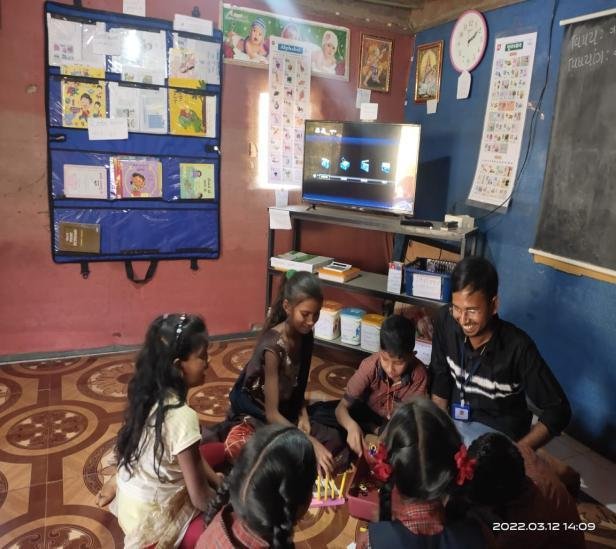
Tribal students in remote villages speak a dialect different from the school language, which undermines learning across all subjects. Per ASER 2024, only 23.4% of Class 3 students in Gujarat's government schools can read a Class 2 text, and just 44.8% by Class 5.
Launched in October 2024 by Ms. Sujata Shah, Nipun@Reading trains local youth in Foundational Literacy pedagogy to support committed government-school teachers. MECT leads execution; Arch is the knowledge partner and Nachiketa Trust handles program design. Phase 1 reached 6 schools with 80%+ of students at or above ASER level competencies. Phase 2 (2026-28) expands to 14 schools.
| Schools | Grades | Students | Community teachers |
|---|---|---|---|
| 6 existing | Balvatika – STD 2 | 290 | 6 |
| 6 existing | STD 3 – 5 | 240 | 6 |
| 8 new | Balvatika – STD 2 | 320 | 8 |
| 14 total | Balvatika – STD 5 | 850 | 20 |
Budget: ₹24.8 lakh (≈ ₹3,800/student); a further ₹7.5 lakh of coordinator and library costs is funded by Nachiketa Trust.
Project 2 · Khadki Boys' Hostel
Launched in late 2024 with a capacity of 100, the hostel lets boys from remote hamlets attend the local ZP secondary school, where almost no public transport runs. MECT, which favours girls in Kukeri, chose to support boys here. The hostel provides remedial education, board-exam coaching, quality nutrition, and exposure to organic farming, cooking, sports, yoga and martial arts, plus Jivan Kala sessions led by the Managing Trustee.
- 90%+ of Grade 10 hostel boys to clear board exams.
- Top performers (70%+) admitted to Shantaba Vidhyalay for Engineering/Medical tracks.
- Grow from 20 boys today to 40 in 2026-27 and 80+ in 2027-28.
Budget: ₹12 lakh (40 students at ~₹30,000 each).
Project 3 · Ecology Farming (Millet Revival)
Over 75% of local tribal adults survive on ~3 acres of dispersed hilly land. Modern chemical-and-machinery farming has steadily leached the soil. Coordinator Ms. Sujata set up demonstration plots to revive traditional, low-cost, sustainable practices without sacrificing profit, partnering with Pragati Abhiyan (Nashik).
- 15–20 villages with committed farmers reviving Nagli (finger millet).
- Field demos on Jivamrit, Bijamrit, slurry and organic pesticides using neem, nirgudi & desi cow urine.
- Annual Millet Mela to celebrate and spread the movement.
- 2026-27 additions: vermicomposting kits, farm ponds, kitchen-garden kits for 100 women, seed multiplication plots and a pilot food-processing space for millet products.
Coverage: 85 core farmers + ~100 waiting, growing to 300. Budget: ₹19.5 lakh.